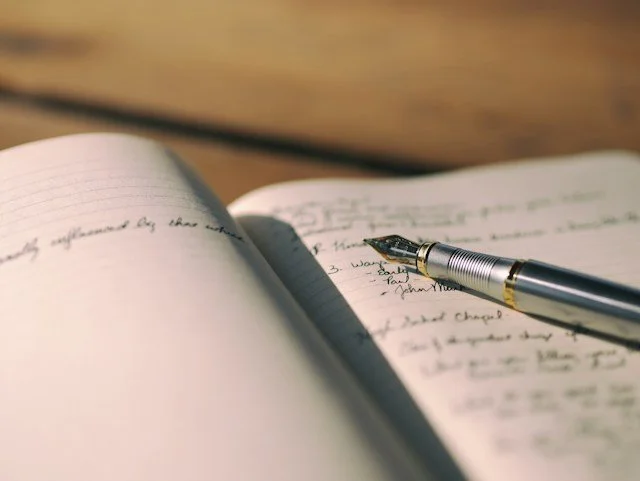
Photo by Aaron Burden on Unsplash
I attended an unconventional school for my undergrad: Friends World College (now part of Long Island University), where as part of our work each semester, we were required to create a “process journal” of what we worked on. This included reflecting on any traditional classes we took, as well as any research or internships or independent studies or creative work we did. We reflected on what made us take the course or do the internship/research/study; on the process of doing the thing and what we discovered about the subject and ourselves; and of course, what we actually learned.
Some may dismiss this as self-indulgent navel-gazing, but compared to traditional colleges, where students generally pick done-for-you courses with clear learning objectives that are part of specific requirements for a major, it was necessary for us to think about what we were doing and why, as well as what we learned. We became self-directed learners, driven by our own curiosity, guided by faculty mentors.
I’ll wager to say, I learned far more than I did in traditional courses at my first university, where learning was dominated by cramming to take a test. At Friends World, we weren’t graded; the faculty wrote our evaluations based on our process journals, our other written work or projects, and extensive conversations.
When it came time for my senior thesis, I wrote a collection of short stories, and a creative process journal to go with them. (And yes, I also got certified to teach English as a Second Language, and worked as a teacher in a local London borough, so I had job prospects at the end of my degree.) I learned a lot about how I work as a writer, and what supports my creativity (and what doesn’t). I focused on my craft development and how I applied what I learned to my writing.
Many studies have shown that reflecting on your learning helps you learn better, retain information longer, and so on. It forces you to engage with your learning, as opposed to trying to memorize without context.
Of course, many students don’t want to do the “extra work” involved in reflective learning strategies, even though not doing that work results in wasted time “studying” things they will never actually learn, just regurgitate for some test.
It’s the same with writers, I suspect: many reading this will say it’s not worth their already-limited writing time.
So how do you do it, and how can it help your writing?
Keeping a Writing Process Journal can take many forms - whatever is most useful for you. There is no one “right way” to do it.
You can record your writing process each day: how many words you wrote, or what you worked on, or questions about the project. You can write about challenges with a particular scene. You can jot down ideas for characters or scenes to come (or fill in backstory that might be relevant).
The reason?
Doing this kind of writing keeps you engaged and connected with the story even when you can’t do a long writing session;
Questions marinate in the brain overnight, often providing an answer once you come back to the page;
It helps solve story issues;
It serves as a place to play with other ideas and mull over decisions without committing to making them part of the story;
It serves as a record of what you did and when as protection against AI accusations;
You get a feeling of accomplishment when you look back over your journal and realize how far you’ve come, and see your journey in a tangible way.
Writing Process Journaling can be part of your regular journaling practice (if you have one). Or you can designate a notebook for each particular project. That can be especially helpful, as you can look back on your story development as you go and keep a record of each project.
Process Journaling doesn't need to be long. A few words or sentences is fine. Or pages of figuring things out - whatever works for you! You can write in your Process Journal before your writing session, as a way of warming up or reconnecting to the material. And you can write a bit after your session, noting down the word count and any other questions or ideas that might help you jump back in more easily the next time.
I’ve kept various notebooks as Process Journals for all of my writing projects over the years. They are messy. Sometimes abandoned partway through the project. Sometimes with jumps from draft to draft. Again, there is no one right way to use a Process Journal. But if you haven’t used one, you may want to think about starting. There are many benefits!
Do you have a Process Journal for your writing projects? How do you use it? Let us know in the comments!
If you like this, head on over to the Contact Page and sign up to get my monthly newsletter featuring tips on creativity, productivity, and the writer’s craft.